What Makes a Good Ear Impression Scan for Hearing Aids?

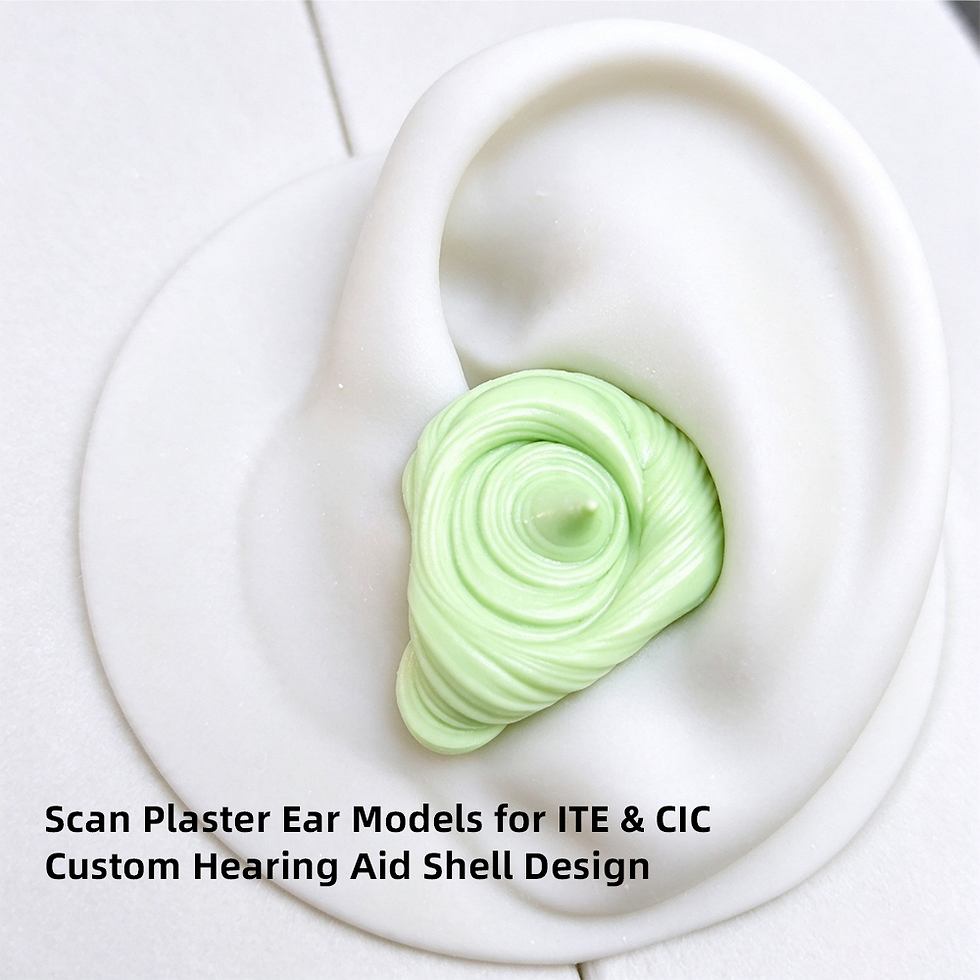
A high-quality ear impression scan is the foundation of comfortable, accurate, and effective hearing aids. As the hearing care industry continues to shift toward digital workflows, understanding what defines a good ear impression scan has become essential for audiologists, hearing aid manufacturers, and hearing aid laboratories.
From improving fit accuracy to reducing remakes, digital ear impression scanning plays a critical role in modern hearing aid production.
Why Ear Impression Scan Quality Matters

Custom hearing aids—especially in-the-ear (ITE), CIC, and IIC devices—must fit precisely within the ear canal. Even minor inaccuracies in an ear impression can lead to:
Poor wearing comfort or pressure points
Acoustic leakage and reduced sound performance
Increased remake rates and longer production cycles
A good ear impression scan ensures that the digital model accurately reflects the physical impression. This accuracy supports precise shell design and enables consistent, repeatable manufacturing results.
Key Factors of a Good Ear Impression Scan

1. Complete and Accurate Geometry
A high-quality ear impression scan must capture the full anatomy of the ear impression, including:
The full length of the ear canal
Canal bends and contours
Helix, concha, and tragus areas (when required)
Any missing data or incomplete geometry can directly compromise the final hearing aid fit and comfort.
2. High Resolution and Fine Detail Capture
An effective ear impression scan should preserve fine surface details such as:
Canal texture and smooth shape transitions
Narrow or deep canal regions
Subtle anatomical variations
High-resolution scanning ensures the digital model is suitable for precise hearing aid shell design, modification, and optimization.
3. Minimal Noise and Clean Scan Data
Scan quality is not defined by resolution alone—data cleanliness is equally important. A good ear impression scan should provide:
Minimal noise points
Smooth, continuous surfaces
Clear and accurate edge definition
Clean scan data reduces the need for manual corrections and significantly improves digital workflow efficiency.
4. Accurate Scale and Dimensional Fidelity
For hearing aids, dimensional accuracy is critical. A high-quality ear impression scan must maintain correct scale without distortion, ensuring the digital model matches the physical impression exactly.
Any deviation in scale can negatively affect comfort, retention, and acoustic performance.
5. Stable and Consistent Scanning Performance
Consistency is essential in professional audiology environments. A reliable ear impression scanning process should deliver:
Repeatable results across different impressions
Stable scanning performance during daily use
Minimal dependence on operator experience
This consistency supports standardized and scalable workflows in both clinics and hearing aid laboratories.
Digital Ear Impression Scanning vs. Traditional Methods
Compared to traditional physical impressions and manual processing, digital ear impression scanning offers clear advantages:
Faster turnaround times
Reduced risk of damage or deformation
Easier digital storage and data sharing
Seamless integration with CAD/CAM systems
A high-quality digital scan bridges the gap between clinical impression taking and digital hearing aid manufacturing.
The Role of Professional Ear Impression Scanners
Dedicated ear impression scanners—such as JME3 Ear Impression Scanner—are designed specifically for audiology applications. These systems provide:
High-resolution scanning tailored for ear impressions
Stable and repeatable results for daily professional use
Clean scan data optimized for hearing aid CAD software
Using a professional ear impression scanner helps hearing care providers improve efficiency, reduce remakes, and deliver better outcomes for hearing aid users.